

I’ve been sitting with an idea for a while now. It’s not fully formed yet and that’s exactly why I’m writing about it.
One of the things I try to be deliberate about as a leader is not sharing an idea until I’ve actually stress-tested it. It’s easy to post a hot take. It’s harder and more valuable to sit with something, pull it apart, and figure out whether it actually holds up. So when I tell you this model is still developing, that’s not a disclaimer. It’s the point.
What I’m building towards is something I’m calling Intelligent Quality Leadership. It’s an attempt to articulate what quality engineering needs to become, not in five years, but right now, in response to the way software itself is fundamentally changing.
And I think it starts with an uncomfortable truth.
The mental model most of us were trained on, find the defect, raise the ticket, block the release, was built for a world of deterministic software. That world is shrinking fast.
When a system is powered by machine learning, when outputs are probabilistic rather than predictable, when the same input can produce a different result depending on context, traditional pass/fail testing doesn’t just become less effective. It becomes the wrong tool entirely. And yet many teams, many organisations, and many leaders are still reaching for it by default.
I don’t think that’s laziness. I think it’s a gap. A gap between how fast the technology has moved and how slowly our operating models have caught up. Intelligent Quality Leadership is my attempt to start closing that gap, for myself, for my team, and hopefully as something useful for the wider community to interrogate and build on.
The Triangle
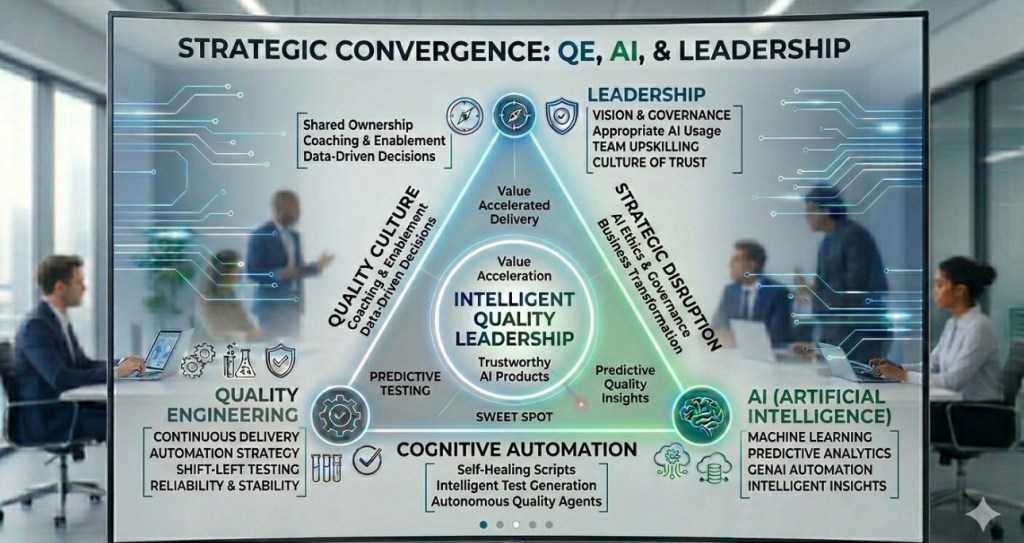
The model is built around a triangle of three converging forces: Quality Engineering, Artificial Intelligence, and Leadership. None of these are new on their own. What’s new and what I think is underexplored is what happens when you treat them not as separate disciplines but as a single, interdependent system. Each edge of the triangle produces something distinct. And where all three meet is where the real opportunity lives.
QE + AI = Cognitive Automation
For years, the conversation around automation in testing has been stuck in the same place: how do we write more scripts, faster, and make them less brittle? It’s the right problem, but it’s a narrow frame. The advent of AI gives us the opportunity to rethink automation at a deeper level, not just executing checks more efficiently, but building systems that learn, adapt, and self-correct. Self-healing test suites. Intelligent test generation based on risk and change patterns. Autonomous quality agents that surface insight rather than just results.
The goal here isn’t to automate testing. It’s to free human engineers from the repetitive and predictable, so they can focus their judgment on what actually requires judgment, the complex, the ambiguous, the genuinely unknown. That’s a fundamentally different value proposition for quality teams, and it’s one worth fighting for.
AI + Leadership = Strategic Disruption
Here’s the edge of the triangle I think gets the least attention, and yet it might be the most consequential. As AI becomes embedded in the products we build, we inherit a new class of risk, one that most testing frameworks were never designed to address. Hallucinations. Bias baked into training data. Outputs that are technically coherent but ethically problematic. Security vulnerabilities that emerge not from broken code but from model behaviour. These aren’t edge cases. They are the new normal.
And quality leaders are uniquely positioned to be the people who build the guardrails, the “Appropriate Use Frameworks” that define how AI is used responsibly within our organisations. This isn’t just a technical challenge. It’s a leadership one. It requires us to develop a point of view on ethics, on governance, on what trustworthy AI actually looks like in practice. That’s a bigger brief than most of us were hired for. It’s also, I’d argue, exactly where we need to step up.
Leadership + QE = Quality Culture
The third edge is one I’ve written about before from different angles, but the AI context sharpens it considerably. Shifting left, embedding quality thinking earlier in the delivery process, has been the aspiration for years. In an AI-driven environment, it’s no longer aspirational. It’s essential. You cannot bolt quality onto a probabilistic system at the end of the pipeline. You have to engineer it in from the start.
That means quality leaders moving from a role of gatekeeping to one of coaching. It means building the capability across the whole engineering team to own quality outcomes, not just the QE specialists. It means data-driven decisions about risk, shared ownership of the outcome, and a culture where quality is a value rather than a function. I won’t pretend this is easy to build. Culture change never is. But I do think the urgency created by AI adoption gives us a genuine opening to make the case in a way that wasn’t always available before.
The Sweet Spot: Intelligent Quality Leadership
When Cognitive Automation, Strategic Disruption, and Quality Culture operate together, when they’re aligned rather than siloed, something qualitatively different becomes possible. Quality stops being a phase in a delivery pipeline and starts being a property of the system itself. Teams stop reacting to defects and start anticipating risk. Leaders stop reporting on quality and start shaping it. And the products that leave our teams are ones we can genuinely stand behind, not just because they passed the tests, but because they were built with integrity from the ground up.
That’s what Intelligent Quality Leadership points towards. Not a destination I’ve arrived at, but a direction I’m committed to travelling in.
I want to be clear about where I am with this. The model feels right to me, the triangle holds, the convergence point is real, but I’m still figuring out how it translates into day-to-day practice. What does a team operating this way actually look like? How do you measure progress towards it? Where does it break down, and what do you do when it does? Those are the questions I’m working through, and I don’t have clean answers yet.
What I do know is that the teams and leaders who will navigate the next decade well are the ones who start asking these questions now, before the pressure of a specific crisis forces the conversation. The technology isn’t waiting. The risks aren’t waiting. The opportunity to shape what quality engineering becomes, rather than just react to what it’s becoming, has a window, and I’d rather be deliberate about it than caught flat-footed.
I’d genuinely love to pressure-test this further. If you’re a QE practitioner or an engineering leader, where does this model resonate with your experience and where does it fall short? Which edge of the triangle feels like the biggest challenge in your context right now? The conversation is as much a part of the model as the model itself.
More to come on this as it develops. As always, thanks for reading.

 Simon Prior